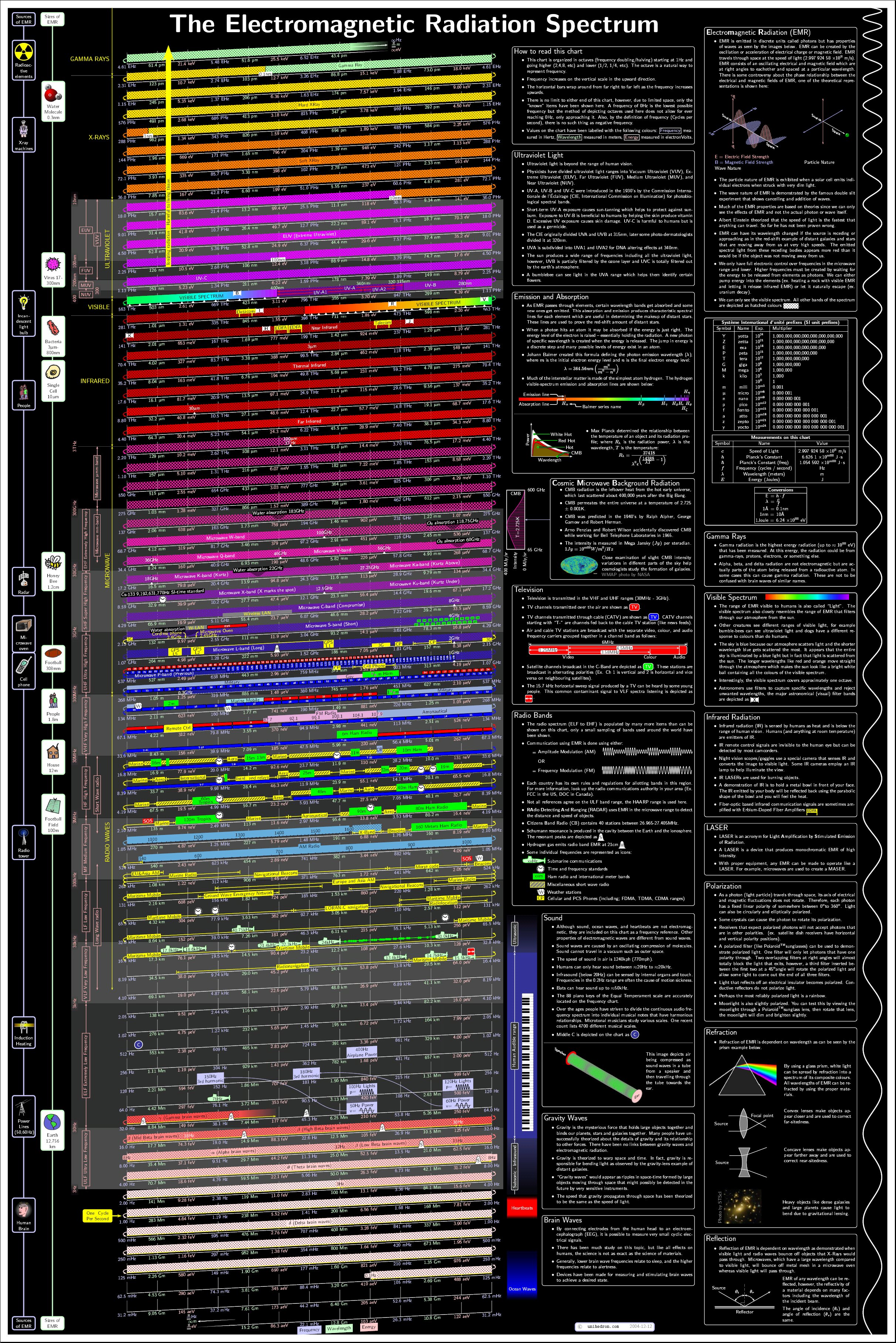
I was studying a chart on Electromagnetic radiation (found here) - Another thought struck me.
What if we're going about fusion all wrong?
According to E=mc^2, The amount of mass is the energy Divided by speed of light * speed of light. (or m=e/c^2). In a very, VERY watered down layman's terms, this tells me that when you pump an electromagnetic wave to the square of the speed of light, it becomes mass.
Why?
According to the chart, a electromagnetic field runs counter to the wavelength of the actual photon's wavelength. Therefore, it makes sense to me that when both the wavelength of the field and the wavelength of the photon are brought to link to one another, thereby creating mass. After all, what is a quark but an electromagnetic field of a specific wavelength... IE, c^2?
Hypothesis 4 - When electromagnetic fields match nearby electromagnetic waves at the speed of light by the speed of light, wavelengths of photons 'stabelize' upon themselves with magnetic fields, causing them to fold into mass.
Tuesday, March 23, 2010

Sunday, March 21, 2010
This just all seems to me to be logical...
This just all seems to me to be logical. While imaginative, the "issues" with quantum theory are due only to the lack of insight on the part of those who take issue. I am not upholding quantum physics to be true, quite the opposite: I am saying it is accurate in some respects, but incomplete. One will notice that The only 'issues' people run into with quantum physics is insisting that particles are indeed something solid and unchangeable, and quarks don't seem to work that way. ...Is this really so hard to imagine?
Hypothesis 3: An atom is a semi-static wave function.
Hypothesis 3: An atom in an interferometer is running through the device as a wavefunction. When applying another wavefunction, the structure of the wavefunction can be determined on either side at half the value, as the wave is still in motion. Therefore, "particles" are nothing more than the way we observe the wavefunction of all things... atoms are merely waves of dark energy contained to a semi-static state, where they interact within their own atom more easily and readily than within the wavefunction of another, until forced to do otherwise (such as in the event of electrons moving through a cable).
An aside:
In answer to the issues of Schrodinger's theory: (I.E. - The stick a cat in a box with a radioactive-isotope-triggered-poison-machine experiment)
1 - Why is it that we never see superpositions of such macroscopically distinguishable states (such as cats being dead and alive at the same time) and instruments both recording and not recording signals?) After all, we do see the effects of such superposition in the interferometer when the porthole is closed, and of course in the two-slit experiment, but there the states involved were microscopic ones involving individual atoms.
A: - Atoms are quarks and by their very nature, 'semi-static' wave functions. Though they can be predicted, their state does fluctuate in relation to the wavefunctions around it. However, a macroscopic object will constantly be surrounded by other wavefunctions, and therefore, stable. Schrodinger cat will die, will die once, and it will be irrelevant whether or not this consciously observed.
2 - Even if there was a way of getting Schrodinger cat states out of the way before we look, is there not still further wavefunction collapse necessary to remove all the remaining possible options bar the one we actually end up observing? Thus, Schrodinger's cat could be dead, alive, or both. Removing the both option still does not tell us how one of the other two possibilities is discarded when we open the box.
A: - The cat was never in two states at once. Again, a macroscopic object will constantly be surrounded by other wavefunctions, and therefore, stable, unlike it's atomic counterpart. Again, Schrodinger cat will die, will die once, and it will be irrelevant whether or not this consciously observed.
An aside:
In answer to the issues of Schrodinger's theory: (I.E. - The stick a cat in a box with a radioactive-isotope-triggered-poison-machine experiment)
1 - Why is it that we never see superpositions of such macroscopically distinguishable states (such as cats being dead and alive at the same time) and instruments both recording and not recording signals?) After all, we do see the effects of such superposition in the interferometer when the porthole is closed, and of course in the two-slit experiment, but there the states involved were microscopic ones involving individual atoms.
A: - Atoms are quarks and by their very nature, 'semi-static' wave functions. Though they can be predicted, their state does fluctuate in relation to the wavefunctions around it. However, a macroscopic object will constantly be surrounded by other wavefunctions, and therefore, stable. Schrodinger cat will die, will die once, and it will be irrelevant whether or not this consciously observed.
2 - Even if there was a way of getting Schrodinger cat states out of the way before we look, is there not still further wavefunction collapse necessary to remove all the remaining possible options bar the one we actually end up observing? Thus, Schrodinger's cat could be dead, alive, or both. Removing the both option still does not tell us how one of the other two possibilities is discarded when we open the box.
A: - The cat was never in two states at once. Again, a macroscopic object will constantly be surrounded by other wavefunctions, and therefore, stable, unlike it's atomic counterpart. Again, Schrodinger cat will die, will die once, and it will be irrelevant whether or not this consciously observed.
Hypotheses: Neither a photon nor an electron is truly a particle.
I would like to do experiments based on the following 2 hypotheses.
Hypothesis 1:
A photon is NOT a particle. Albeit a photon acts entirely like a particle when bouncing off an electron, in reality it is merely the dark energy that forms the quark moving in a specific wave interacting with the dark energy "folded" within the electron that causes it to bounce away. This in no way negates the effect of the two slit experiment, except for the fact that the photon was never truly a particle to begin with, merely a direction of energy; but changes the understanding of the effects of Compton Scattering.
Given: The empty space of a quark is composed primarily of dark energy.
Hypothesis 2:
An electron is not truly a particle: It is a 'magnetospheric' effect around the quarks composing a proton and a neutron, and a moving radical electron is, in reality, dark energy in motion as a wave... hence the inability to capture its current location, (a phenomenon which in part led to the theory of quantum physics.)
Hypothesis 1:
A photon is NOT a particle. Albeit a photon acts entirely like a particle when bouncing off an electron, in reality it is merely the dark energy that forms the quark moving in a specific wave interacting with the dark energy "folded" within the electron that causes it to bounce away. This in no way negates the effect of the two slit experiment, except for the fact that the photon was never truly a particle to begin with, merely a direction of energy; but changes the understanding of the effects of Compton Scattering.
Given: The empty space of a quark is composed primarily of dark energy.
Hypothesis 2:
An electron is not truly a particle: It is a 'magnetospheric' effect around the quarks composing a proton and a neutron, and a moving radical electron is, in reality, dark energy in motion as a wave... hence the inability to capture its current location, (a phenomenon which in part led to the theory of quantum physics.)
Wednesday, March 3, 2010

Tuesday, March 2, 2010

Monday, March 1, 2010
A random thought on the electromagnetic spectrum...
In our world of visible physics, in areas where matter is clustered, as is the case in our world, and that matter crashes into matter, a chain reaction occurs, known as a "wave". External factors eventually slow that wave down, and it usually stops when it either runs out of energy, or hits something that can absorb the wave and transfer the energy, but the energy is merely shifted to another kind of energy, the energy does not go away. Still, for as long as matter is similarly clustered, the energy of the wave can travel.
Therefore, it is only conceivable that electromagnetic waves function in the same principle... only with some kind of "matter" we cannot see. In the quark of any given proton of an atom, Empty space accounts for 80 percent of the energy (mass) in the quark of a proton. Scientists are scrambling with projects such as the Large Ion Collider or the Large Hadron Collider to understand this energy, but it seems as though this can be best described as "Dark" energy, the energy that we now know makes up 70 percent of all energy in the universe. It is measurable in the empty space of an atom, but where atoms are not visible, we are at a loss to see them.
However, it seems feasible that if a wave can travel, there must be someTHING it is traveling through. Does it not only stand to reason that matter, which we know to be naught but bound energy, is really a bound form of this dark energy bound within quarks within sub-atomic particles to fashion our known universe?
it seems to me then that Electromagnetic waves are merely waves of energy not bound within the atom, but waves of energy crashing upon themselves, free to traverse the wilds of the dark energy in our universe. After all, it was just this week it was discovered the effects of gravetomagnetic waves were shown to be no less than one hundred million trillion times larger than Einstein's General Relativity predicts (cite source below). What else are we missing that we don't even know about?
http://news.softpedia.com/news/The-First-Test-That-Proves-General-Theory-of-Relativity-Wrong-20259.shtml
Input, anyone? Your thoughts?
Therefore, it is only conceivable that electromagnetic waves function in the same principle... only with some kind of "matter" we cannot see. In the quark of any given proton of an atom, Empty space accounts for 80 percent of the energy (mass) in the quark of a proton. Scientists are scrambling with projects such as the Large Ion Collider or the Large Hadron Collider to understand this energy, but it seems as though this can be best described as "Dark" energy, the energy that we now know makes up 70 percent of all energy in the universe. It is measurable in the empty space of an atom, but where atoms are not visible, we are at a loss to see them.
However, it seems feasible that if a wave can travel, there must be someTHING it is traveling through. Does it not only stand to reason that matter, which we know to be naught but bound energy, is really a bound form of this dark energy bound within quarks within sub-atomic particles to fashion our known universe?
it seems to me then that Electromagnetic waves are merely waves of energy not bound within the atom, but waves of energy crashing upon themselves, free to traverse the wilds of the dark energy in our universe. After all, it was just this week it was discovered the effects of gravetomagnetic waves were shown to be no less than one hundred million trillion times larger than Einstein's General Relativity predicts (cite source below). What else are we missing that we don't even know about?
http://news.softpedia.com/news/The-First-Test-That-Proves-General-Theory-of-Relativity-Wrong-20259.shtml
Input, anyone? Your thoughts?
Okay I lied.
Okay I lied, NOT the last one. But ANY OF WHO WHO HAVE EVER MET ME will understand why...
http://imgs.xkcd.com/comics/blagofaire.png
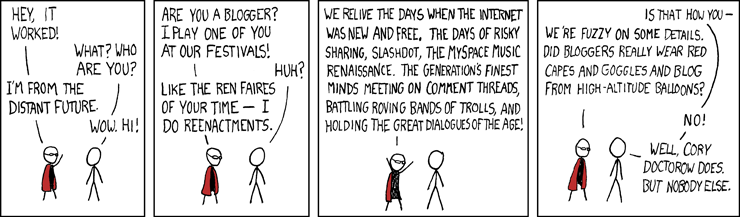
http://imgs.xkcd.com/comics/blagofaire.png

Subscribe to:
Posts (Atom)