I've decided it takes a certain amount of dissatisfaction to be truly ambitious regarding... well, anything, really. What is ambition if not being driven to make some sort of a change? Hence, I've realized I'm not a truly ambitious person simply because I'm fairly content with my position.
Though I don't work as a teacher (something I really want to do), I still help people. Day in and day out. My job is technical support, and I'm very comfortable with what I do. Furthermore, I'm good at it. I have the people skills to do well and the technical know-how to keep my customers informed. Sure, my job doesn't pay as well as some other jobs in my field, but it pays. I'm able to bring home a paycheck at the end of the day, and I've helped people get connected to the world. The job brings me satisfaction.
Then there are those in my job who decide they must move on. They must move higher up, or they must move to another line of work. I see these people at work, and they are not satisfied. They don't feel they are being paid enough, or they don't like dealing with people day in and day out. Every personality has a different take on the job. And for those who are always trying to climb to the top... I imagine it's just never enough.
...The more I look at it, the more satisfied I am with who and where I am. I have a good job, a loving wife, and a great life. No, I don't want to stay in my current job forever... I don't even want to stay in Arizona forever... but I have it good nonetheless. I suppose that's why I'm not truly ambitious.
Just some thoughts. That was all.
Thursday, April 29, 2010

Chromium OS
If I'm reading this developer's calendar correctly, the Code for the Google Chromium OS should be completed by tomorrow!
http://sites.google.com/a/chromium.org/dev/developers/calendar
I SERIOUSLY want a netbook running this Operating system. Without the need to programs on the computer, but rather using apps, all the docs and everything regarding the service will all be on the net. Personally, I think this is going to completely change the way people look at computers and devices, and I can't wait to get my hands on it.
I know the OS itself isn't suppossed to be RELEASED and available for sale until the 2nd half of this year, But I've been waiting since I heard about the project.
Tuesday, April 6, 2010
Here's what I want to make: A fusion.
Here's what I want to make.
Not a website. Not a database. Not a Portal or a social network. A fusion.
Something that seamlessly integrates who and where you are on the internet.
Something that knows if you are on your smart phone, or at your desktop, or in your email. Something that knows if you're visiting a guest computer, or at your home.
Something that will notify other "friend" users if you are available currently via twitter, or phone, or email when they check on their phones, twitter, email, or webTV.
Something where they can initiate a video chat... a text message... a voice message that you read as text.
Something that knows if you're at work, it needs to send you a text message instead of call you.
Something that will tell you if you have a video message waiting for you somewhere if your phone can't play it.
Something that will let others link you to what they have discovered, or to their photos or playlists or RSS Feeds in a simple manner.
Something that can use your phone's GPS if you wish to make the whole thing automatically seamless
Something that will never use GPS if you don't.
Something that will let anyone leave you a message if you're in the shower.
In short... I want to fuse the web into something functional.
...Now... Any coders out there with any good ideas?
Tuesday, March 23, 2010
I seem to be obsessed with this idea of electromagnetic waves...
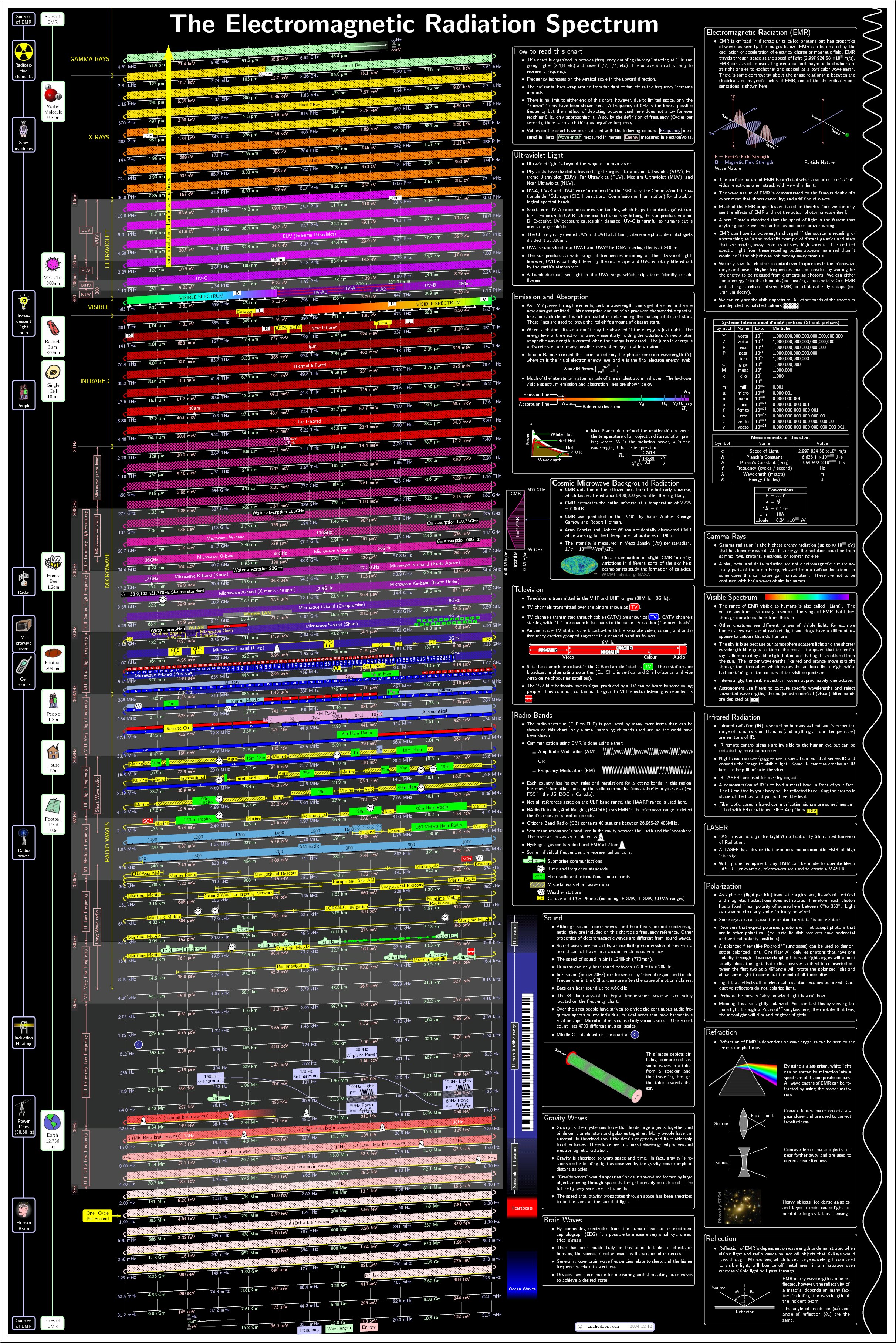
I was studying a chart on Electromagnetic radiation (found here) - Another thought struck me.
What if we're going about fusion all wrong?
According to E=mc^2, The amount of mass is the energy Divided by speed of light * speed of light. (or m=e/c^2). In a very, VERY watered down layman's terms, this tells me that when you pump an electromagnetic wave to the square of the speed of light, it becomes mass.
Why?
According to the chart, a electromagnetic field runs counter to the wavelength of the actual photon's wavelength. Therefore, it makes sense to me that when both the wavelength of the field and the wavelength of the photon are brought to link to one another, thereby creating mass. After all, what is a quark but an electromagnetic field of a specific wavelength... IE, c^2?
Hypothesis 4 - When electromagnetic fields match nearby electromagnetic waves at the speed of light by the speed of light, wavelengths of photons 'stabelize' upon themselves with magnetic fields, causing them to fold into mass.
What if we're going about fusion all wrong?
According to E=mc^2, The amount of mass is the energy Divided by speed of light * speed of light. (or m=e/c^2). In a very, VERY watered down layman's terms, this tells me that when you pump an electromagnetic wave to the square of the speed of light, it becomes mass.
Why?
According to the chart, a electromagnetic field runs counter to the wavelength of the actual photon's wavelength. Therefore, it makes sense to me that when both the wavelength of the field and the wavelength of the photon are brought to link to one another, thereby creating mass. After all, what is a quark but an electromagnetic field of a specific wavelength... IE, c^2?
Hypothesis 4 - When electromagnetic fields match nearby electromagnetic waves at the speed of light by the speed of light, wavelengths of photons 'stabelize' upon themselves with magnetic fields, causing them to fold into mass.
Sunday, March 21, 2010
This just all seems to me to be logical...
This just all seems to me to be logical. While imaginative, the "issues" with quantum theory are due only to the lack of insight on the part of those who take issue. I am not upholding quantum physics to be true, quite the opposite: I am saying it is accurate in some respects, but incomplete. One will notice that The only 'issues' people run into with quantum physics is insisting that particles are indeed something solid and unchangeable, and quarks don't seem to work that way. ...Is this really so hard to imagine?
Hypothesis 3: An atom is a semi-static wave function.
Hypothesis 3: An atom in an interferometer is running through the device as a wavefunction. When applying another wavefunction, the structure of the wavefunction can be determined on either side at half the value, as the wave is still in motion. Therefore, "particles" are nothing more than the way we observe the wavefunction of all things... atoms are merely waves of dark energy contained to a semi-static state, where they interact within their own atom more easily and readily than within the wavefunction of another, until forced to do otherwise (such as in the event of electrons moving through a cable).
An aside:
In answer to the issues of Schrodinger's theory: (I.E. - The stick a cat in a box with a radioactive-isotope-triggered-poison-machine experiment)
1 - Why is it that we never see superpositions of such macroscopically distinguishable states (such as cats being dead and alive at the same time) and instruments both recording and not recording signals?) After all, we do see the effects of such superposition in the interferometer when the porthole is closed, and of course in the two-slit experiment, but there the states involved were microscopic ones involving individual atoms.
A: - Atoms are quarks and by their very nature, 'semi-static' wave functions. Though they can be predicted, their state does fluctuate in relation to the wavefunctions around it. However, a macroscopic object will constantly be surrounded by other wavefunctions, and therefore, stable. Schrodinger cat will die, will die once, and it will be irrelevant whether or not this consciously observed.
2 - Even if there was a way of getting Schrodinger cat states out of the way before we look, is there not still further wavefunction collapse necessary to remove all the remaining possible options bar the one we actually end up observing? Thus, Schrodinger's cat could be dead, alive, or both. Removing the both option still does not tell us how one of the other two possibilities is discarded when we open the box.
A: - The cat was never in two states at once. Again, a macroscopic object will constantly be surrounded by other wavefunctions, and therefore, stable, unlike it's atomic counterpart. Again, Schrodinger cat will die, will die once, and it will be irrelevant whether or not this consciously observed.
Hypotheses: Neither a photon nor an electron is truly a particle.
I would like to do experiments based on the following 2 hypotheses.
Hypothesis 1:
A photon is NOT a particle. Albeit a photon acts entirely like a particle when bouncing off an electron, in reality it is merely the dark energy that forms the quark moving in a specific wave interacting with the dark energy "folded" within the electron that causes it to bounce away. This in no way negates the effect of the two slit experiment, except for the fact that the photon was never truly a particle to begin with, merely a direction of energy; but changes the understanding of the effects of Compton Scattering.
Given: The empty space of a quark is composed primarily of dark energy.
Hypothesis 2:
An electron is not truly a particle: It is a 'magnetospheric' effect around the quarks composing a proton and a neutron, and a moving radical electron is, in reality, dark energy in motion as a wave... hence the inability to capture its current location, (a phenomenon which in part led to the theory of quantum physics.)
Subscribe to:
Posts (Atom)